
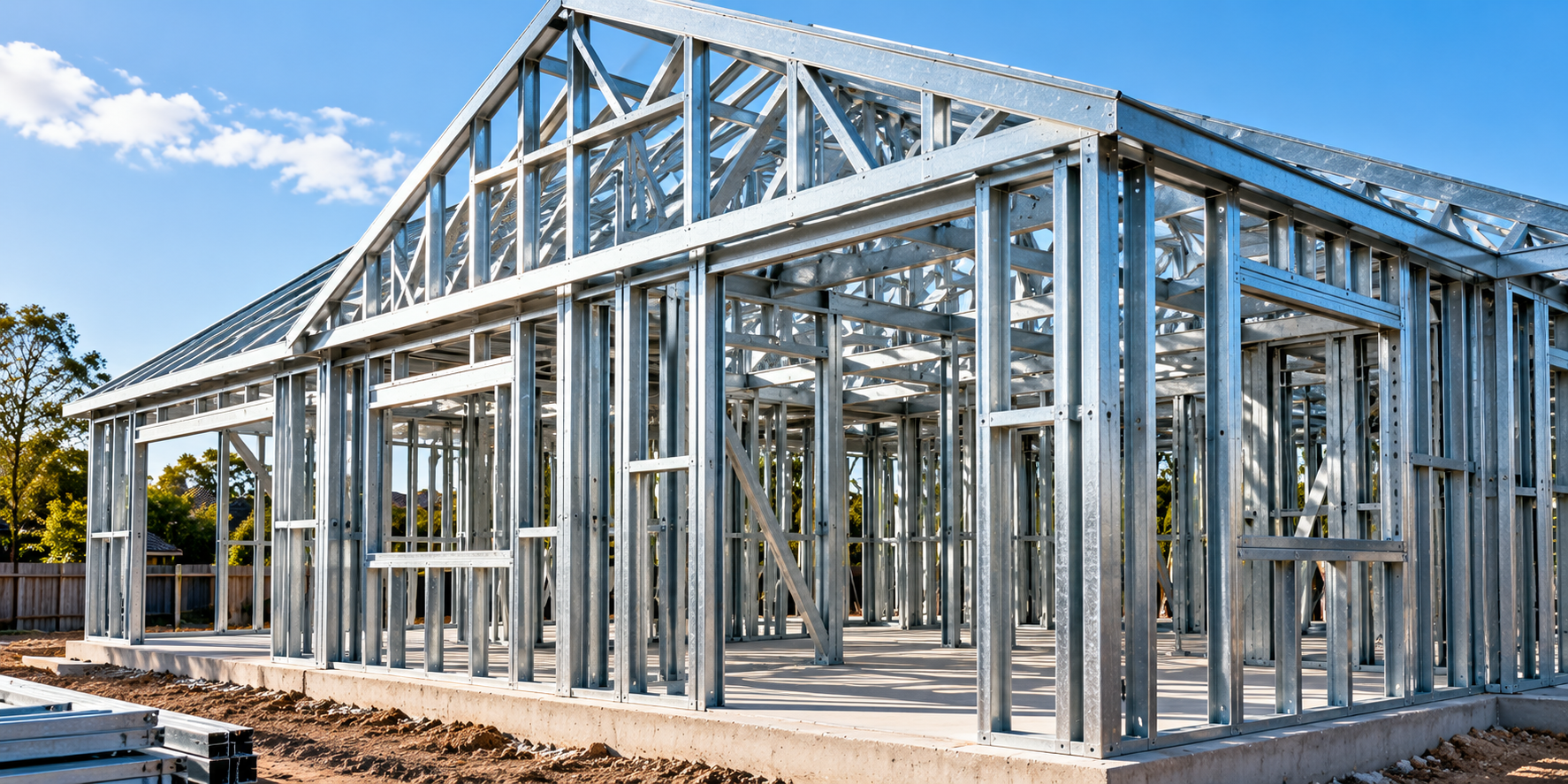
Steel framing has become an important construction method for residential, commercial, industrial, and agricultural projects. Its combination of strength, dimensional consistency, and design flexibility makes it suitable for everything from house frames and workshops to warehouses and large commercial structures.
However, steel framing is not automatically the best option for every project. Building size, structural loads, environmental exposure, labour availability, fabrication requirements, material prices, fire protection, insulation, and long-term maintenance can all influence whether steel is the right choice.
If your project requires structural steel, Super Steel supplies a broad range of steel products including RHS, pipe, plate, structural beams and columns, merchant bar, sheet, purlins, and other building products for construction and fabrication applications.
What Is Steel Framing?
Steel framing is a construction system in which steel members form part or all of the structural framework of a building. These members transfer roof, floor, wall, equipment, wind, and other loads through the structure and ultimately into the foundations.
Depending on the building, a steel-framing system may include:
- Structural beams
- Columns and posts
- RHS and SHS sections
- Joists
- Studs and tracks
- Purlins
- Bracing
- Channels
- Connection plates and brackets
The exact member sizes, grades, thicknesses, finishes, and connection details should be determined from the project’s engineering and design documentation.
Structural Steel Framing vs Light-Gauge Steel Framing
Steel framing generally falls into two broad categories. Although both use steel, they serve different structural purposes and are manufactured differently.
| Feature | Structural Steel Framing | Light-Gauge Steel Framing |
|---|---|---|
| Typical members | Beams, columns, channels, RHS, SHS and heavier structural sections | Thin cold-formed studs, tracks, joists and similar profiles |
| Common projects | Warehouses, factories, commercial buildings, workshops and large-span structures | Homes, townhouses, internal walls, floors, ceilings and some commercial construction |
| Primary role | Carrying significant structural loads and creating larger spans | Light structural framing and building-envelope systems |
| Fabrication | May involve cutting, drilling, welding, plates and shop fabrication | Often supplied as factory-formed sections designed for mechanical fastening |
For heavier construction and fabrication projects, structural steel products available from Super Steel include RHS, pipe, plate, U-beams, columns, merchant bar, sheet and building products.
Benefits of Steel Framing
1. High Strength-to-Weight Ratio
One of steel’s biggest advantages is the amount of structural capacity that can be achieved relative to the weight and cross-sectional size of the material.
This can allow engineers to design frames capable of supporting substantial loads without relying on excessively bulky structural members. It is particularly valuable where buildings require long roof spans, large openings or substantial clear floor areas.
For example, warehouses, workshops and commercial buildings may benefit from steel framing because fewer intermediate columns can sometimes be used when the structure is appropriately engineered.
2. Dimensional Stability
Steel does not shrink, split or warp as its moisture content changes in the same way that timber can.
Consistent dimensions help fabricators and builders create predictable connections, straight frames and repeatable components when the material is manufactured and installed correctly.
This does not mean steel remains completely unchanged under every condition. It expands and contracts with temperature, which engineers must consider when designing long structures, façades and connections.
3. Resistance to Termites and Biological Decay
Steel is not a food source for termites and does not experience biological rot in the same way as timber.
This can be particularly useful in areas where termite management is an important design consideration. However, the rest of the building may still contain timber, paper-faced products or other cellulose materials that require appropriate termite protection.
4. Noncombustible Material
Steel is noncombustible, meaning it does not provide additional fuel to a fire.
However, noncombustible does not mean fireproof. Steel loses strength as temperatures increase, so structural fire protection may still be required depending on the building classification and applicable code.
Protection can include fire-rated linings, sprayed coatings, boards, concrete encasement or other approved systems.
5. Large Spans and Flexible Layouts
Steel is particularly useful where architects and building owners want open spaces without numerous internal supports.
Applications where this can be valuable include:
- Warehouses
- Distribution centres
- Factories
- Aircraft hangars
- Sports facilities
- Retail buildings
- Commercial offices
- Workshops
Steel can also be fabricated into a wide range of shapes and structural configurations, giving engineers considerable flexibility when addressing complex building geometries.
6. Fabrication Before Delivery
Many structural steel components can be measured, cut, drilled, punched or otherwise processed before reaching the job site.
This can reduce the amount of modification required during erection and may improve construction efficiency where dimensions and drawings are accurate.
Super Steel provides steel cutting and selected processing services, including cutting for pipe, RHS, beams and channels as well as cropping and punching for applicable merchant-bar products.
7. Variety of Steel Sections
Steel framing is not limited to one profile. Engineers and fabricators can select sections that suit the load direction, connection requirements, available space and appearance of the project.
| Steel Section | Typical Framing Uses | Why It May Be Selected |
|---|---|---|
| RHS | Frames, beams, posts, supports and trusses | Flat faces, efficient structural shape and straightforward fabrication |
| SHS | Posts, columns and general framing | Symmetrical profile with similar geometry in both axes |
| Structural beams | Floors, roofs and long horizontal spans | Efficient resistance to bending when correctly sized |
| Channels | Framing, bracing, supports and edge members | Open section that can simplify some connection details |
| Angle steel | Bracing, brackets, frames and reinforcement | Simple L-shaped profile suited to many fabricated connections |
| Plate | Base plates, connection plates, brackets and fabricated components | Available in different grades and thicknesses for structural fabrication |
For more detail on hollow sections, see Super Steel’s guide to RHS vs SHS steel or read about the benefits of RHS steel for structural and fabrication projects.
8. Recyclability
Steel can be recovered and recycled at the end of a building’s service life, and new steel products may contain recycled material.
Accurate fabrication can also help reduce avoidable offcuts and site waste.
However, recyclability is only one part of environmental performance. Manufacturing energy, transport distances, building efficiency, maintenance, service life, reuse and eventual recycling should all be considered when evaluating the full lifecycle of a building.
Disadvantages and Challenges of Steel Framing
Steel has significant advantages, but successful steel construction depends on addressing its limitations during design rather than treating them as afterthoughts.
| Consideration | Why It Matters | Common Design Response |
|---|---|---|
| Corrosion | Moisture, salt and chemicals can attack inadequately protected steel | Galvanising, paint systems, protective coatings, drainage and suitable detailing |
| Thermal bridging | Steel conducts heat readily through building-envelope assemblies | Continuous insulation, thermal breaks and appropriate envelope design |
| Fire exposure | Structural capacity decreases at elevated temperatures | Fire-rated assemblies, coatings, boards or encasement where required |
| Specialist installation | Large frames may need cranes, qualified welders or experienced erectors | Plan lifting, access, temporary bracing and fabrication requirements early |
| Price fluctuation | Steel and transport prices can vary with market conditions | Obtain current project-specific material and fabrication quotes |
Corrosion
Unprotected carbon steel can corrode when exposed to suitable combinations of moisture, oxygen, salts or chemicals.
This is especially important for buildings near coastal environments, industrial operations, washdown areas or other locations where aggressive conditions may be present.
Protective approaches can include galvanised steel, coating systems, careful drainage design, avoiding water traps and ensuring cut or welded areas receive appropriate treatment.
Thermal Bridging
Steel conducts heat much more readily than many common insulation materials.
If steel members pass through an insulated building envelope without suitable detailing, they can create thermal bridges that reduce the effective insulation performance of the complete wall or roof assembly.
Continuous insulation, thermal breaks and other envelope strategies may therefore be needed, particularly where energy-efficiency requirements are stringent.
Fire Protection Requirements
A steel member does not need to burn to lose structural capacity. As the temperature of the steel increases during a fire, its strength and stiffness decrease.
Where a specified fire-resistance level is required, structural steel protection should be designed as part of the complete fire strategy.
Specialised Labour and Equipment
Smaller steel frames may be straightforward to fabricate and assemble, while larger projects may require cranes, elevated work equipment, rigging, welding equipment, bolted structural connections and experienced steel erectors.
These requirements can affect both construction cost and scheduling.
How Much Does Steel Framing Cost?
There is no single reliable cost per square metre that applies to every steel-framing project.
The installed cost depends on substantially more than the price of the raw steel. Two buildings with a similar floor area can have very different steel costs because their spans, loads, member sizes, connection details, finishes, fabrication requirements and site conditions differ.
Main Factors Affecting Steel Framing Cost
| Cost Factor | What It Can Include | Why Costs Vary |
|---|---|---|
| Steel material | RHS, beams, columns, channels, plate, angles and other sections | Section size, grade, thickness, finish, quantity and market pricing |
| Fabrication | Cutting, drilling, punching, welding, plates and prepared connections | Complex frames generally require more shop labour and processing |
| Protective finish | Galvanising, painting or specialist coating systems | Environmental exposure and specified coating life affect requirements |
| Transport | Delivery of steel and fabricated members to site | Distance, member length, load size and special transport requirements |
| Erection | Labour, cranes, lifts, rigging, fasteners, welding and temporary bracing | Building height, access and frame complexity can substantially affect site costs |
| Engineering | Structural calculations, drawings and connection design | Complexity, load conditions and project scale vary significantly |
| Fire and thermal systems | Fire protection, insulation and thermal breaks | Building type and performance requirements determine what is necessary |
Material Costs
Steel prices change with supply, demand, manufacturing inputs, international markets and transport conditions.
For this reason, historical cost guides should not replace a current quote based on the actual sections, grades, lengths and quantities required.
Fabrication Costs
Buying structural steel is not necessarily the same as buying finished structural members.
Depending on the project, steel may need to be cut to length, drilled, punched, welded, fitted with plates, prepared for bolting or coated before installation.
Super Steel provides cutting and selected processing for applicable products. If you already have a bill of materials or cutting schedule, using those specifications when requesting a quote can make the requirement clearer.
Transportation
Long structural members and large orders require suitable vehicles and handling arrangements.
Delivery distance, bundle size, member length and access to the job site can all influence transport cost.
Super Steel operates from Coopers Plains in Brisbane and supplies customers across Queensland and other regions through its distribution network. You can view the Super Steel service area for more information.
Installation
The installation portion of the budget can include steel erectors, crane hire, access equipment, welding, bolting, temporary supports and safety controls.
A frame that is inexpensive to purchase but difficult to transport or erect may not deliver the lowest overall installed cost.
Steel Framing vs Wood Framing
Steel and timber framing have different advantages. Choosing between them should be based on the complete building rather than simply comparing the price of the framing material.
| Factor | Steel Framing | Wood Framing |
|---|---|---|
| Termites | Steel itself is not consumed by termites | Requires appropriate termite-management measures where risk exists |
| Moisture-related movement | Does not shrink or swell from moisture content changes like timber | Can shrink, swell, twist or warp as moisture conditions change |
| Corrosion/decay | Requires corrosion protection where exposure demands it | Can be affected by rot, fungi and moisture if not appropriately protected |
| Thermal conductivity | High; thermal bridging needs careful detailing | Lower thermal conductivity than steel |
| On-site modification | May require cutting tools, drilling, welding or specialist equipment | Often straightforward to cut and modify with conventional carpentry tools |
| Large-span potential | Well suited to large structural spans when engineered appropriately | Engineered timber systems can span substantial distances but use different design approaches |
The better option depends on local material costs, trade availability, building size, structural loads, fire requirements, termite exposure, corrosion conditions, insulation strategy, construction time and long-term maintenance.
Common Applications of Steel Framing
Residential Buildings
Cold-formed steel framing can be used for houses, townhouses, apartments and other residential construction.
Its dimensional consistency and resistance to termite attack can make it attractive for certain projects, although insulation, acoustic performance, condensation and thermal bridging still require appropriate building-envelope design.
Commercial Buildings
Offices, retail spaces, restaurants, showrooms and other commercial buildings frequently incorporate structural steel because it can support large openings and flexible interior layouts.
The ability to create wider structural bays may also make it easier for a building to accommodate future tenant fit-outs or changes in internal use.
Warehouses and Distribution Centres
Warehouses are among the most common examples of steel-framed construction.
Large clear spans can help reduce the number of columns within storage and operating areas, improving flexibility for racking, forklifts, loading equipment and future layout changes.
Factories and Industrial Facilities
Factories, processing facilities and workshops may need frames capable of accommodating machinery, mezzanines, cranes, suspended services, heavy loads or large access openings.
Steel systems can be engineered around these requirements rather than forcing industrial equipment into a conventional building layout.
Agricultural Buildings
Steel framing is also used for sheds, barns, machinery shelters, workshops and other rural buildings.
Environmental exposure should be considered carefully. Buildings exposed to rain, livestock waste, fertilisers, moisture or coastal conditions may require additional corrosion protection.
Super Steel also provides guidance on choosing steel for rural fencing and structures.
Renovations and Building Additions
Structural steel can be useful where an existing building needs a larger opening, additional support, an extension or reinforcement.
Beams and columns may allow loads to be redirected around new openings, but the existing structure and foundations must first be assessed by appropriately qualified professionals.
Fabrication and Equipment Frames
Not every steel frame forms part of a building. RHS, SHS, channel, plate and merchant bar are also widely used for machinery bases, equipment supports, platforms, trailers, gates and custom fabricated structures.
For smaller fabricated components, Super Steel’s guide to merchant bar applications covers flat bar, angle, round bar, square bar and channel.
What Steel Products Are Used in Framing?
A framing project may require several different types of steel rather than a single profile.
| Product | Possible Use |
|---|---|
| RHS / SHS | Posts, frames, beams, trusses, equipment supports and fabricated assemblies |
| Structural beams and columns | Primary building framing and larger structural spans |
| Steel plate | Base plates, connection plates, gussets, stiffeners and fabricated components |
| Angle steel | Bracing, brackets, supports and connection details |
| Channel | Framing, edge members, supports and general fabrication |
| Purlins | Supporting roof or wall cladding as part of an engineered building system |
Where plate is included in the design, see Super Steel’s guide to selecting steel plate for a project.
How Long Does Steel Framing Last?
There is no single lifespan that applies to every steel-framed building.
A properly designed, protected and maintained steel structure can provide a long service life, but longevity depends heavily on the environment and the way the building manages moisture.
Important factors include:
- Exposure to rain and condensation
- Coastal salt
- Industrial chemicals
- Protective coating specification
- Drainage and detailing
- Damage to coatings
- Quality of fabrication and installation
- Inspection frequency
- Ongoing maintenance
Areas where water, salt or chemicals can accumulate deserve particular attention during inspection.
Is Steel Framing Sustainable?
Steel has several characteristics that can support sustainable construction. It is recyclable, can incorporate recycled material and can be fabricated accurately to reduce unnecessary waste.
Prefabricated members may also allow more controlled material use than extensive cutting and modification on site.
However, sustainability should be considered across the complete lifecycle of a structure. Steel production is energy intensive, so assessing a building solely on the recyclability of its frame provides an incomplete picture.
A broader lifecycle assessment can consider:
- Raw material sourcing
- Steel manufacturing
- Amount of material required
- Transportation distance
- Fabrication waste
- Building energy use
- Maintenance requirements
- Service life
- Potential reuse
- End-of-life recycling
What to Consider Before Choosing Steel Framing
Steel should be selected as part of a complete structural and building-envelope strategy rather than simply because it is strong or durable.
Before ordering material, work through the major project requirements.
| Question | Why It Matters |
|---|---|
| What loads must the frame support? | Loads affect the required section, thickness, grade, bracing and connection design. |
| What steel sections are specified? | Changing a profile or thickness can change structural performance. |
| Is the structure exposed to moisture, salt or chemicals? | Environmental exposure determines the level of corrosion protection required. |
| What fire rating applies? | Structural members may require an additional fire-protection system. |
| How will thermal bridging be managed? | Poor detailing can reduce the effective performance of insulation. |
| Can members be transported and lifted? | Length, weight and site access can affect transport and erection planning. |
| What processing is required? | Cutting, drilling, punching, welding and coating can affect lead time and cost. |
| What is the total installed cost? | Comparing raw material prices alone may overlook fabrication, delivery and erection costs. |
Ordering Steel for a Framing Project
If the frame has already been designed, the engineering drawings, bill of materials or cutting schedule should form the basis of the steel order.
Useful information to provide when requesting a quote includes:
- Steel product or section type
- Section dimensions
- Wall or plate thickness
- Steel grade where specified
- Required finish
- Length of each member
- Quantity
- Cutting requirements
- Other processing requirements
- Delivery location
Super Steel supplies steel for engineering, fabrication, construction, industrial projects and other applications. Its Brisbane range includes galvanised and painted RHS, pipe, plate, beams, columns, merchant bar, sheet and building products. :contentReference[oaicite:2]{index=2}
If you already have a steel schedule, contact Super Steel with the sizes, lengths, quantities and required processing so the team can review the material requirement.
Frequently Asked Questions
Is steel framing stronger than wood?
Steel generally has much higher material strength than common structural timber, but this does not mean every steel-framed building is automatically stronger than every timber-framed building. Structural performance depends on member sizes, connections, bracing, geometry, loads and the complete engineered system.
Does steel framing rust?
Steel can corrode when moisture and other environmental conditions allow corrosion to occur. Galvanising, paint systems, suitable material selection, drainage and appropriate building details can help manage this risk.
Can termites damage a steel frame?
Termites do not consume steel. However, other components within the building may still contain timber or cellulose-based materials, so termite protection may still form part of the overall building design.
Is steel framing fireproof?
No. Steel is noncombustible, but it loses structural strength at elevated temperatures. Where required, fire-rated linings, coatings or other structural fire-protection measures must be incorporated into the building design.
Is steel framing expensive?
It can be more or less economical depending on the project. Material price, fabrication, transportation, erection, cranes, coatings, fire protection, engineering and programme savings should all be considered when comparing options.
Can steel framing be used for houses?
Yes. Cold-formed steel framing can be used for residential walls, floors and roof systems when properly designed and installed in accordance with applicable codes, standards and engineering requirements.
Is RHS suitable for structural framing?
RHS is widely used for frames, posts, beams, trusses, platforms and other fabricated structures. Its flat faces can simplify welding, bolting and mounting components. The section size, wall thickness, grade and orientation still need to match the project’s engineering requirements. See the Super Steel guide to RHS steel for structural fabrication for more detail.
Can steel be supplied cut to length?
Yes. Super Steel states that cutting is available for applicable pipe, RHS, beams and channels, with additional cropping and punching capabilities for merchant bars such as flats, rounds and angles. :contentReference[oaicite:3]{index=3}
Choosing Steel for Your Framing Project
Steel framing combines high strength, dimensional consistency, flexibility and resistance to termites and biological decay. These characteristics make it suitable for applications ranging from residential framing and workshops to commercial buildings, warehouses and industrial facilities.
Its advantages must still be balanced against corrosion protection, thermal bridging, fire resistance, fabrication, transportation, erection requirements and total project cost.
For structural or load-bearing projects, always work from the relevant engineering and design documentation rather than selecting steel sections based on appearance or general rules of thumb.
If you have a bill of materials, cutting list or structural steel schedule ready, browse Super Steel’s steel products and processing options or contact Super Steel with your required sections, lengths, quantities and delivery details.