
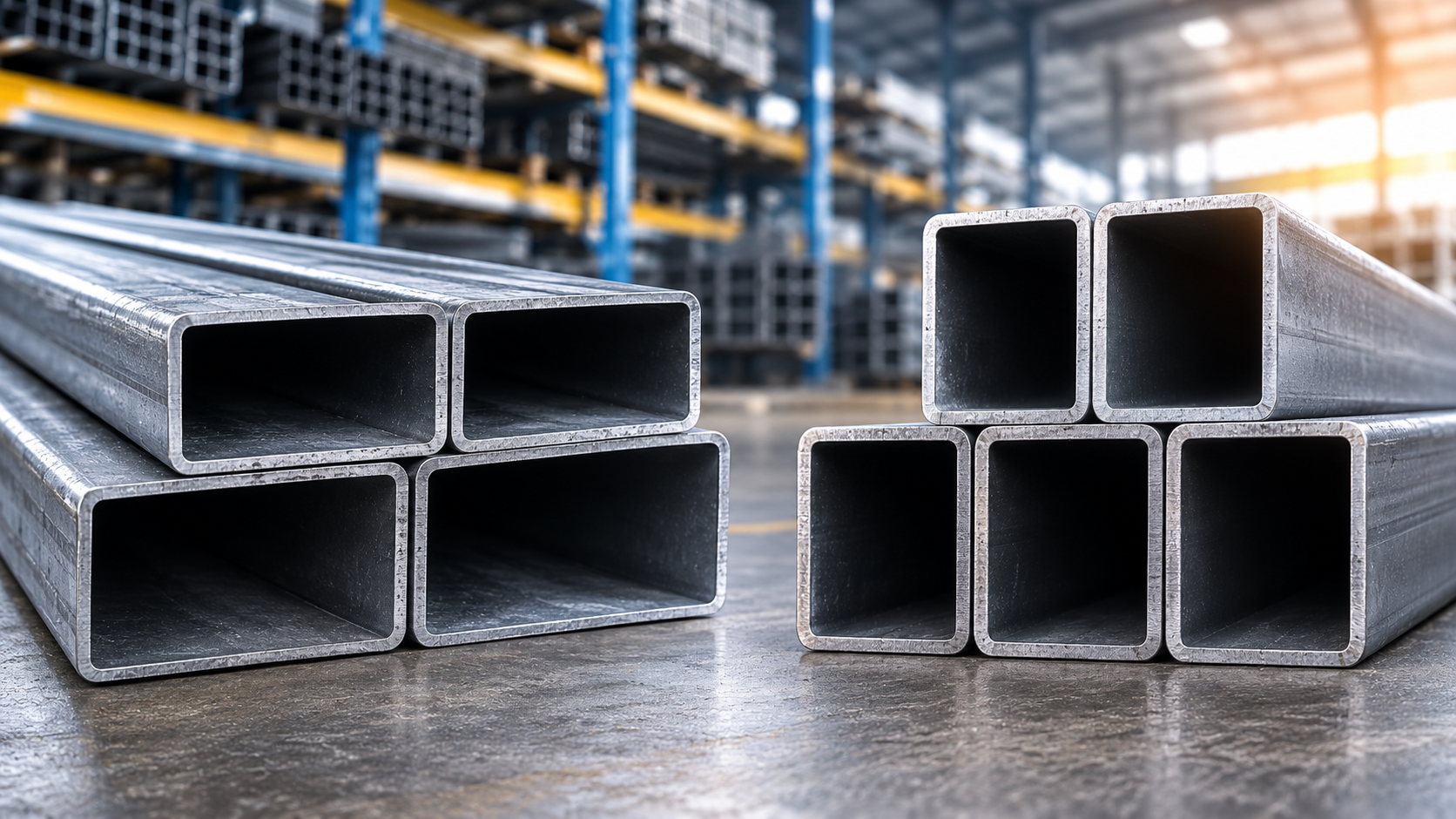
Choosing the right steel section is essential for ensuring the strength, stability, and cost-effectiveness of any construction or fabrication project. Two of the most commonly used hollow structural sections are Rectangular Hollow Sections (RHS) and Square Hollow Sections (SHS). While both offer excellent strength and durability, each is better suited to specific applications.
Super Steel Australia supplies a wide selection of steel products for construction, structural fabrication, agricultural projects, machinery, fencing, and general engineering applications.
This guide explains the differences between RHS and SHS steel, their advantages, common uses, and the key factors to consider when selecting the best option for your project.
What Is RHS Steel?
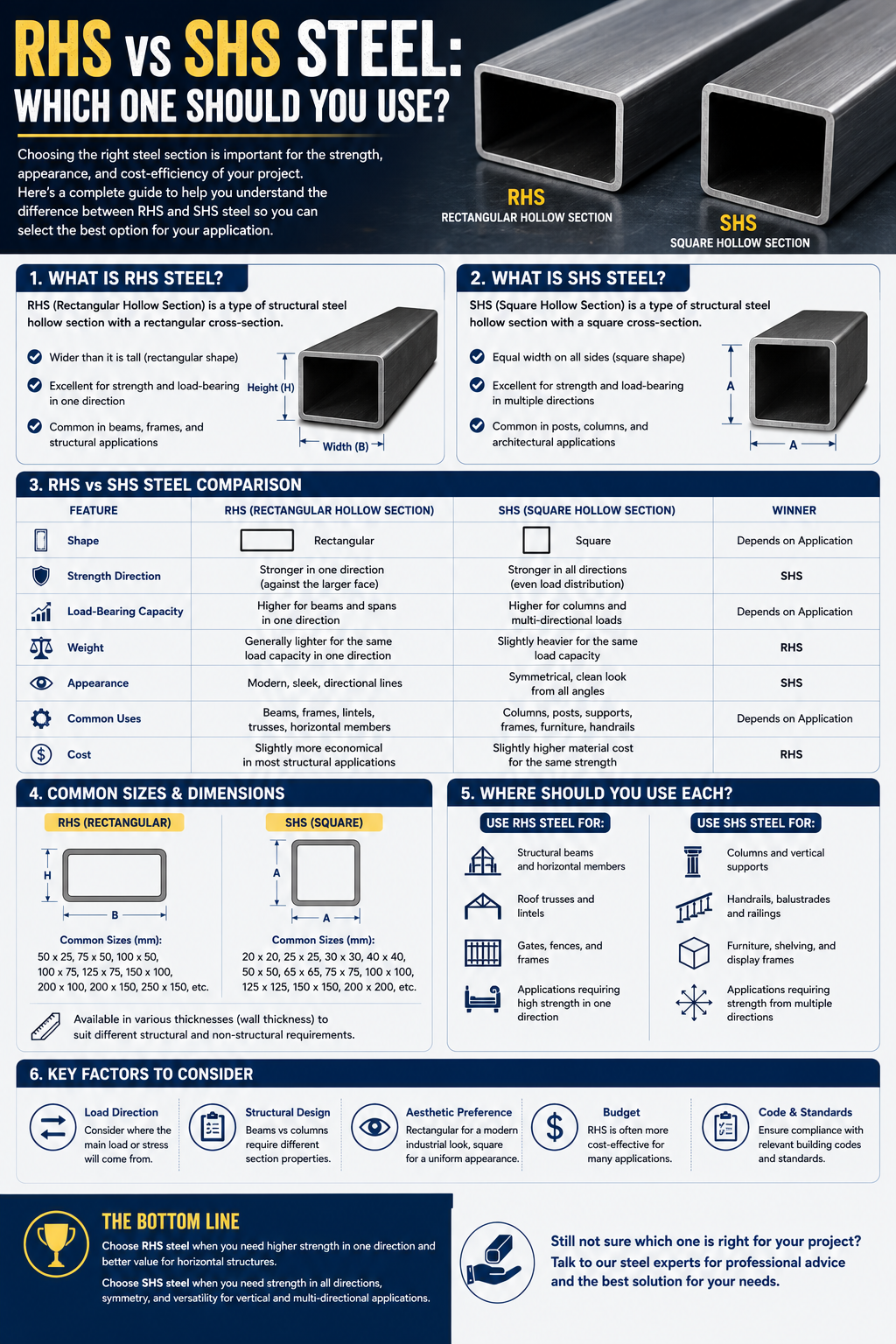
Rectangular Hollow Section (RHS) is a welded steel tube with a rectangular cross-section. It is manufactured in a wide range of sizes and wall thicknesses to meet structural, engineering, and fabrication requirements.
The longer and shorter sides of RHS provide different strength characteristics, making it ideal for applications where loads are primarily applied in one direction. Its flat surfaces also make it practical for welding, bolting, joining, and attaching plates or brackets.
Learn more about the benefits of RHS steel for structural and fabrication projects.
Common Uses of RHS Steel
- Building frames
- Roof trusses
- Bridges
- Structural beams
- Vehicle chassis
- Agricultural equipment
- Machinery frames
- Industrial platforms
What Is SHS Steel?
Square Hollow Section (SHS) is a steel tube with equal-width sides, giving it a square cross-section.
Its symmetrical design provides similar strength in both horizontal and vertical directions, making it suitable for projects where balanced load distribution and a clean appearance are important.
SHS is commonly included within broader structural steel systems because it provides a combination of strength, uniform geometry, and straightforward fabrication.
Common Uses of SHS Steel
- Building columns
- Fencing
- Gates
- Handrails
- Furniture
- Sign structures
- Architectural features
- General fabrication
RHS vs. SHS: Key Differences
Although both are hollow structural sections, they differ in shape, performance, and ideal applications.
| Feature | RHS Steel | SHS Steel |
|---|---|---|
| Shape | Rectangle | Square |
| Strength Distribution | Greater along one axis | Balanced in both axes |
| Best For | Beams, frames, load-bearing structures | Columns, posts, architectural projects |
| Appearance | Modern rectangular profile | Symmetrical and uniform |
| Load Direction | Ideal for directional loads | Suitable for multidirectional loads |
| Design Flexibility | High | High |
The best choice depends on the structural requirements, load direction, connection details, and design goals of your project.
Advantages of RHS Steel
1. Excellent Bending Strength
Because of its rectangular shape, RHS provides greater resistance to bending along its stronger axis, making it well suited for beams and horizontal structural members.
The orientation of the section is important. Placing the deeper side in the direction of the primary bending load can improve stiffness and structural efficiency.
2. Efficient Material Usage
RHS often provides an excellent strength-to-weight ratio, allowing engineers to achieve the required structural performance while managing material usage.
This can make RHS a practical option for frames, platforms, trailer components, and other applications where unnecessary weight should be avoided.
3. Ideal for Structural Frames
The rectangular profile integrates well into building frames, equipment supports, agricultural structures, and industrial platforms where loads are primarily directional.
Its broad, flat surfaces also provide convenient areas for:
- Welding
- Bolting
- Mounting plates
- Attaching brackets
- Joining other structural members
4. Wide Range of Sizes
RHS is available in numerous dimensions, steel grades, finishes, and wall thicknesses, making it suitable for everything from light fabrication to heavy structural applications.
A knowledgeable steel supplier can help identify suitable section sizes and available finishes for the intended project.
Advantages of SHS Steel
1. Uniform Strength
Because all four sides are equal, SHS offers similar structural performance in multiple directions, making it a practical option for columns, posts, supports, and frameworks.
This balanced geometry can simplify section orientation where loads may be applied from more than one direction.
2. Clean Architectural Appearance
The symmetrical shape creates a neat, modern look that is popular in architectural, residential, commercial, and decorative projects.
SHS is frequently used where the steel remains visible after installation, including:
- Gates
- Handrails
- Pergolas
- Furniture
- Sign frames
- Architectural supports
3. Easy Fabrication
SHS is easy to cut, weld, drill, and assemble, making it a versatile option for fabricators and contractors.
Its equal-width faces can also simplify alignment and connection detailing during fabrication.
4. Versatile Applications
Its balanced geometry makes SHS suitable for structural, commercial, residential, agricultural, and decorative uses.
Both RHS and SHS are regularly used in rural fencing and structural projects because they provide flat connection surfaces and good resistance to bending and twisting.
When Should You Choose RHS?
RHS is often the better choice when your project requires:
- Structural beams
- Roof supports
- Bridge components
- Vehicle frames
- Equipment bases
- Heavy-duty fabrication
- Trailer components
- Applications where loads act mainly in one direction
The rectangular shape provides excellent stiffness where directional strength is required.
RHS may also be preferred when a wider face is needed for mounting equipment, welding plates, bolting components, or supporting cladding.
When Should You Choose SHS?
SHS is often preferred for projects involving:
- Columns
- Fence posts
- Gates
- Handrails
- Architectural frameworks
- Outdoor structures
- Furniture
- Decorative steelwork
- Sign supports
Its square profile provides balanced performance while delivering a clean, professional appearance.
SHS can also be easier to orient during installation because each side has the same dimensions.
Factors to Consider Before Choosing
Before selecting RHS or SHS steel, evaluate the following.
Load Requirements
Determine:
- Load magnitude
- Load direction
- Bending forces
- Compression requirements
- Torsional forces
- Support spacing
Directional loading often favours RHS, while balanced loading may make SHS the better choice.
For safety-critical or load-bearing structures, section selection should be confirmed by a qualified structural engineer.
Structural Design
Consider how the section fits into the overall design.
Engineers often select the shape that provides the required structural performance while minimising weight, fabrication complexity, and material costs.
The section depth, width, wall thickness, steel grade, and orientation can all affect performance.
Fabrication Requirements
Both RHS and SHS are easy to fabricate, but the project may dictate one shape over the other based on:
- Connection details
- Welding requirements
- Mounting surfaces
- Bracket placement
- Joint design
- Required cut lengths
- Finished appearance
Super Steel Australia provides processing and steel cutting services for pipe, RHS, beams, channels, and other steel products, helping customers receive material in the lengths required for fabrication.
Appearance
For exposed structures, the visual profile can influence material selection.
- RHS creates a sleek, elongated appearance.
- SHS offers a balanced, modern, and symmetrical look.
The selected shape should complement the scale and design of the finished structure.
Budget
Material costs vary depending on:
- Steel grade
- Section size
- Wall thickness
- Finish or coating
- Required length
- Market conditions
- Availability
Selecting the most efficient section for the required load can help optimise project costs.
However, choosing a lighter or thinner section without confirming structural suitability may create safety, performance, or durability problems.
Environmental Exposure
For outdoor applications, consider whether the section will be exposed to:
- Rain
- Humidity
- Salt-laden air
- Soil contact
- Chemicals
- Standing water
- Industrial pollutants
Galvanised or appropriately coated RHS and SHS may be preferable for exposed outdoor environments.
Any welded or cut areas may also require suitable corrosion-protection treatment after fabrication.
Common Materials Used for RHS and SHS
Both RHS and SHS are commonly manufactured from:
- Carbon steel
- Mild steel
- High-strength structural steel
- Galvanised steel
- Weather-resistant steel for specific applications
The appropriate material depends on the project’s structural requirements, environmental conditions, fabrication methods, and applicable standards.
Super Steel Australia stocks steel, galvanised products, pipe, RHS, and other materials for structural, fabrication, commercial, and rural applications.
RHS and SHS Compared With Other Steel Sections
RHS and SHS are part of the hollow structural section family, which can also include Circular Hollow Sections (CHS).
Each profile offers different benefits:
- RHS: Flat faces and directional bending strength
- SHS: Balanced geometry and uniform appearance
- CHS: Good torsional performance and smooth circular profile
- Steel pipe: Available in different shapes, sizes, wall thicknesses, and specifications for structural or fluid-handling applications
This steel pipe selection guide provides additional information about choosing between RHS, SHS, CHS, and other pipe profiles.
Common Mistakes to Avoid
Avoid these common errors when selecting hollow steel sections:
- Choosing a section based only on appearance
- Ignoring load direction and structural requirements
- Selecting an incorrect wall thickness
- Using the section in the wrong orientation
- Overlooking corrosion protection for outdoor applications
- Failing to consider connection and welding requirements
- Assuming all steel grades provide the same performance
- Failing to comply with local building codes or engineering specifications
Consult a qualified engineer for projects involving significant structural loads or safety-critical applications.
Frequently Asked Questions
Is RHS stronger than SHS?
Neither is universally stronger. RHS generally offers greater bending resistance along its stronger axis, while SHS provides more uniform strength in multiple directions.
The better choice depends on the section dimensions, wall thickness, steel grade, orientation, loading conditions, and application.
Which is better for columns?
SHS is commonly used for columns because its symmetrical shape provides balanced load-bearing characteristics and a clean architectural appearance.
However, the final section must still be sized according to the applied loads, unsupported length, connection details, and engineering requirements.
Which is better for beams?
RHS is often preferred for beams because its deeper rectangular profile can provide greater bending stiffness along one axis when installed in the correct orientation.
Can RHS and SHS be welded?
Yes. Both RHS and SHS are widely used in welded structures.
Proper welding procedures should be followed based on the steel grade, wall thickness, coating, joint design, and project specifications.
Galvanised sections require additional safety precautions and may need corrosion protection reapplied around welded areas.
Can RHS and SHS be cut to custom lengths?
Yes. Hollow sections can be cut to suit specific fabrication and installation requirements.
Using professional steel cutting services can improve accuracy, reduce onsite labour, and minimise unnecessary material waste.
Which is better for outdoor structures?
Both RHS and SHS can be used outdoors when properly protected against corrosion.
Galvanised or appropriately coated sections are often selected for:
- Fencing
- Gates
- Pergolas
- Agricultural structures
- Carports
- Handrails
- Outdoor frames
The appropriate finish depends on the environment and expected exposure.
Is SHS more expensive than RHS?
Pricing depends on the section dimensions, wall thickness, grade, finish, length, availability, and current steel market conditions.
Neither profile is always more expensive. Cost comparisons should be made between sections that meet the same structural and fabrication requirements.
Can RHS and SHS be used together?
Yes. RHS and SHS are frequently combined within the same structure.
For example, SHS may be used for vertical posts while RHS is used for horizontal beams, rails, or supports.
Connection details should be designed to transfer loads correctly between the different sections.
Final Thoughts
Both Rectangular Hollow Sections (RHS) and Square Hollow Sections (SHS) are versatile, durable, and widely used in construction, engineering, agricultural projects, and fabrication. The right choice depends on your project’s structural requirements, load direction, design preferences, connection details, and environmental conditions.
If your project requires superior bending strength along one axis—such as beams, equipment supports, or structural frames—RHS is often the preferred option. If you need balanced strength, clean aesthetics, and versatility for columns, posts, gates, or architectural features, SHS is typically the better fit.
Super Steel Australia supplies steel products for structural, fabrication, rural, commercial, and industrial applications. By understanding the strengths of each section and consulting relevant engineering standards when necessary, you can select the most suitable steel profile for a safe, efficient, and long-lasting project.