

Steel pipes are a go-to material across construction, plumbing, fabrication, and industrial work because they’re strong, widely available, and adaptable to almost any build. But “steel pipe” isn’t one single product. With so many choices—outer diameter (OD), wall thickness, grade, finish, and protective coatings—selecting the wrong one can lead to avoidable problems like bending, premature rust, leaks, failed welds, or higher long-term maintenance costs.
Choosing the right steel pipe directly affects:
- Strength and load capacity (will it hold weight without flexing?)
- Safety and compliance (does it meet pressure or structural requirements?)
- Corrosion resistance (will it survive outdoors, underground, or in wet areas?)
- Fabrication success (will it weld, cut, and join cleanly?)
- Total project cost (cheaper upfront can become expensive long-term)
Whether you’re building a residential frame, installing fencing or handrails, fabricating a custom trailer or structure, or sourcing pipe for industrial processing, this guide will help you choose the best steel pipe for your application—with fewer mistakes and better performance over time.
🧱 Why Choose Steel Pipes?
Steel pipes remain one of the most trusted materials because they offer a rare balance of strength, durability, and versatility. They can handle high loads, resist impact, and maintain performance across a wide range of temperatures and working conditions—especially when paired with the right finish or coating.
Unlike many alternative materials, steel pipe also works well in mixed projects where you need a material that can serve multiple roles (e.g., structural support + a clean aesthetic + weldability). That’s why it shows up everywhere from building sites to workshops, farms, factories, and transport manufacturing.
✅ Key Benefits of Steel Pipes
1) High tensile strength for structural performance
Steel pipes are naturally strong for their size and weight, which makes them ideal for load-bearing applications like posts, frames, supports, and bracing. Their strength-to-size ratio helps reduce bulk while still delivering serious capacity—especially when you choose the correct wall thickness.
2) Excellent durability under impact, pressure, and stress
Steel handles real-world abuse. It resists dents, knocks, vibration, and repeated stress cycles far better than many plastics or lightweight metals. That’s a big reason steel pipe is common in industrial environments, scaffolding, trailers, and outdoor structures where bumps and wear are unavoidable.
3) Corrosion resistance (with the right coating or finish)
Bare steel will rust if exposed to moisture and oxygen, but steel pipes can be protected with finishes like:
- Galvanising (zinc coating for outdoor and wet environments)
- Powder coating (durable outer finish for aesthetics and protection)
- Paint systems (budget-friendly corrosion barrier)
- Stainless steel (best-in-class corrosion resistance for harsh environments)
Choosing the right protection can dramatically increase lifespan—especially for coastal areas, underground installs, wet zones, and chemical exposure.
4) Wide availability in sizes, thicknesses, and profiles
Steel pipe is available in a huge range of:
- Outer diameters (OD)
- Wall thicknesses
- Lengths
- Grades and standards
- Round, square, and rectangular profiles
That availability makes planning easier—because you can usually find a spec that fits your design without expensive custom fabrication.
5) Cost-effective long-term (strong ROI over the lifespan)
Steel pipe might not always be the cheapest upfront option, but it often wins on total value because it lasts longer and requires fewer replacements. Understanding what affects steel pricing can also help evaluate total lifecycle cost. When properly coated and installed, it offers:
- lower maintenance costs
- fewer failures over time
- better performance under load and weather
6) Easy to fabricate, weld, cut, drill, and connect
Steel pipe is extremely fabrication-friendly. It can be:
- cut to size
- welded for strong joins
- drilled and bolted
- threaded (for plumbing/pressure systems)
- coupled using mechanical fittings
That makes it a favourite for custom builds and projects where parts need to be adjusted on-site.
Bottom line: steel pipe is used in both heavy-duty and everyday applications because it’s reliable, adaptable, and proven.

🏗️ Common Uses for Steel Pipes
Steel pipes aren’t limited to one industry—they’re used anywhere strength and durability matter.
Structural frameworks (columns, bracing, supports)
Steel pipe is often used for carports, pergolas, structural posts, roof supports, and bracing systems because it delivers strong load performance in a clean, efficient profile. For broader applications, see our beginner guide to structural steel.
Fencing and balustrades (posts, rails, gates)
Galvanised steel pipe is a popular choice for fence posts, handrails, guardrails, and gates—especially where timber may warp, rot, or require frequent replacement.
Water and gas pipelines (pressure and flow systems)
In plumbing and gas, the right pipe standard matters. Steel pipe is used for pressure systems because it can handle high stress—when correctly graded, threaded or welded, and protected against corrosion.
Scaffolding systems (temporary support and access)
Steel is a standard in scaffolding because it must handle dynamic loads, repeated use, and harsh site conditions while maintaining safety and rigidity.
Industrial processing systems (chemical, mechanical, manufacturing)
Steel piping is used in factories and plants for conveying materials, air, fluids, and gases—often with specific requirements for temperature, pressure, and chemical exposure.
Automotive and trailer manufacturing (frames, drawbars, bracing)
Steel pipe is widely used in trailers, ute racks, chassis components, braces, and drawbars because it resists flexing and holds up under vibration and repeated road stress.
🧾 Key Factors to Consider When Choosing Steel Pipes
Choosing the right steel pipe isn’t just about grabbing the nearest diameter off the shelf. The best option depends on what the pipe will do, where it will be installed, how much load or pressure it must handle, and how it will be finished (galvanised, painted, powder-coated, etc.). Below are the most important decision points—written in a practical, build-ready way.
1) Intended Application
Start with the end use. The application determines:
- Required strength (load-bearing vs decorative)
- Resistance requirements (pressure, corrosion, impact)
- Finish and appearance (visible architectural vs hidden structural)
- Compliance with standards (especially for structural or regulated work)
Quick guide: application → recommended pipe type
| Application | Recommended pipe type |
|---|---|
| Structural framing | RHS/SHS (square/rectangular) or CHS (circular) structural steel |
| Water/gas pipelines | Black steel or galvanised steel pipe (match the service type + standard requirements) |
| Handrails or fencing | Galvanised medium or pre-galvanised pipe for outdoor durability |
| Heavy-duty supports | Seamless or thick-walled ERW pipes for higher load and impact tolerance |
Practical tip: If your project is outdoors, near the coast, or exposed to rain/irrigation, make corrosion resistance a priority. If the pipe will be load-bearing, wall thickness + grade matter more than appearance.
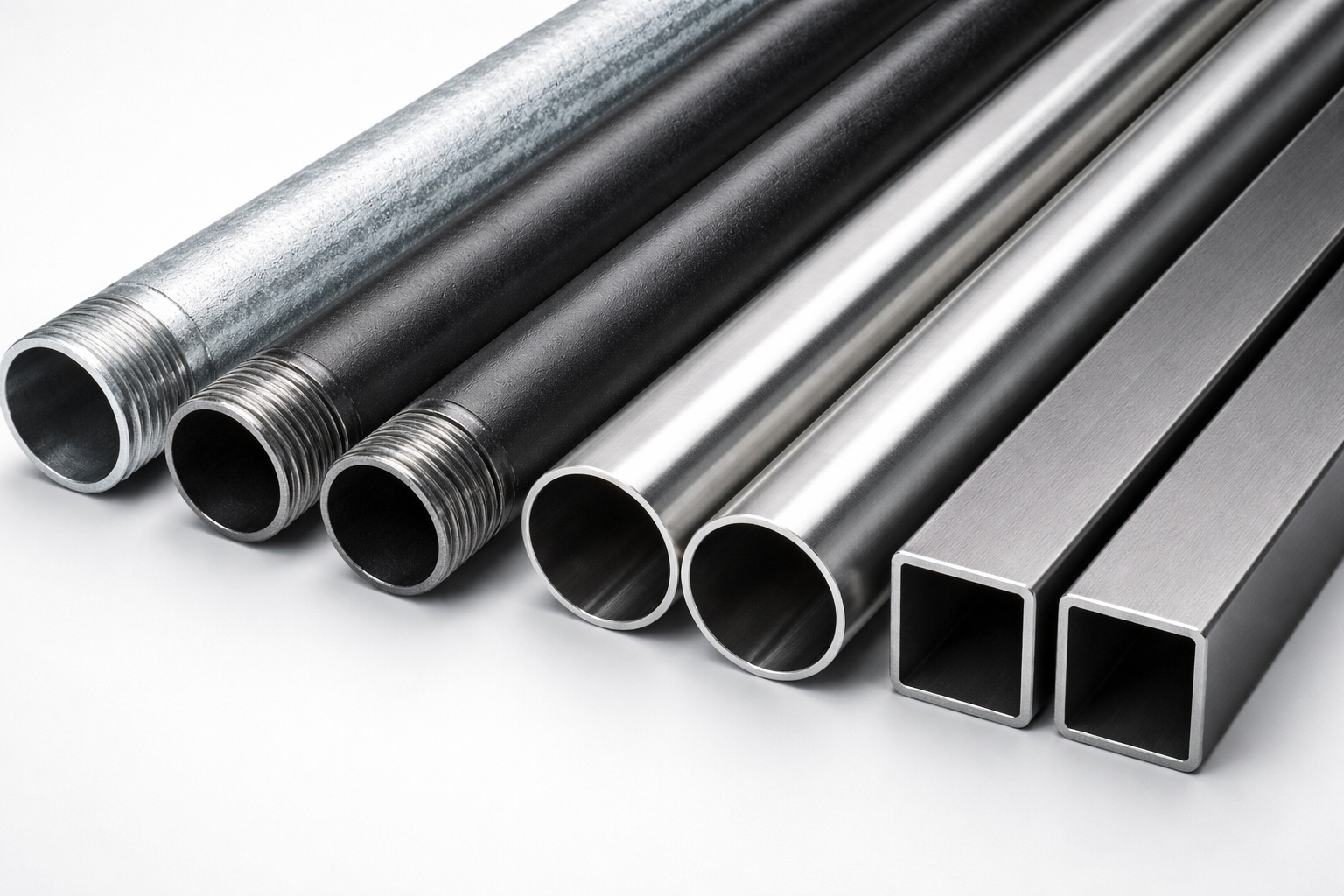
2) Pipe Shape (RHS vs SHS vs CHS vs Round Pipe)
Shape affects strength, stiffness, connection options, and how easy it is to build clean corners and brackets.
RHS (Rectangular Hollow Section)
Best when you need flat faces for bolting, welding plates, or mounting panels.
Learn more about the benefits of RHS steel in structural fabrication.
- Great for frames, beams, pergolas, platforms, trailer bodies
- Offers strong resistance in one main direction (depending on orientation)
- Easy to align and fabricate with square cuts
SHS (Square Hollow Section)
A popular “all-rounder” for structural and architectural work.
- Balanced strength in both directions
- Common for posts, columns, gates, frames, bollards
- Neat, modern look for visible builds
CHS (Circular Hollow Section)
Often chosen for columns and round posts because it distributes stress evenly.
- Excellent for vertical posts/columns
- Performs well under multi-directional loads (wind, vibration, movement)
- Often used in structural supports, columns, and heavy-duty posts
Round pipe (plumbing/fencing/scaffolding style)
Used widely for non-structural and service applications, but also common in outdoor projects.
- Ideal for fencing rails, handrails, pipework, scaffolding
- Easy to clamp and couple with standard fittings
- Often supplied in galvanised options for outdoor use
Quick decision rule:
- Need flat faces + easy mounting? RHS/SHS
- Need a strong post/column with clean load distribution? CHS
- Need pipe fittings / clamping / fluid systems? Round pipe
3) Steel Grade & Standards (Australia)
Understanding steel grades is essential when selecting pipe for structural applications. Read our guide to steel grades explained.
For Australian projects, grades and standards help ensure the pipe matches the mechanical strength and coating requirements of the job—especially for structural builds.
Common standards you’ll see:
- AS/NZS 1163 – Structural steel hollow sections (RHS/SHS/CHS for structural use)
- AS 1074 – Steel tubes and tubulars for ordinary service
- AS/NZS 4792 – Hot-dip galvanised coatings
Grades (e.g., C350, C250)
Grade markings like C350 or C250 indicate mechanical strength (higher number = generally higher strength). Picking the right grade matters when the pipe is:
- supporting roofs, decks, platforms
- holding retaining or lateral loads
- used in trailers, drawbars, bracing
- part of a compliance-sensitive build
Tip: If the pipe is structural, don’t substitute “ordinary service” pipe unless you’re sure it meets the structural requirement. Structural hollow sections exist for a reason: predictable performance.
4) Wall Thickness (Pipe Schedule / Strength)
Wall thickness is one of the biggest drivers of:
- strength and stiffness
- impact resistance
- pressure capability
- weld quality and distortion risk
- overall weight + cost
Common thickness categories:
- Light wall
- Easier to cut, drill, and weld
- Good for light-duty frames and non-critical structures
- Can dent or flex more easily
- Medium wall
- Most common for fencing, posts, general structural use
- A practical balance of strength + cost + workability
- Heavy wall (often “Schedule 40+” in pipe terms)
- Used for high load, high wear, or pressurised systems
- More resistant to denting and bending
- More weight, higher material cost, more effort to cut/weld
📌 Tip: Heavier wall = stronger pipe, but also more weight and cost. Choose thickness based on real demands (load/pressure/environment), not just “bigger is safer.”
5) Finishes & Coatings (Rust Protection + Appearance)
The finish you choose has a huge impact on how long your steel pipe will last—especially outdoors or in wet, corrosive environments. The right coating can prevent early rust, reduce maintenance, and improve the pipe’s appearance for visible builds.
Finish type → best use (quick guide)
| Finish Type | Best Use |
|---|---|
| Galvanised (Hot-dip) | Outdoor projects, wet zones, coastal areas, corrosion-prone environments |
| Pre-galv (mill finish) | Light-duty fencing, indoor use, low-exposure areas |
| Black steel (raw) | Welding, fabrication, painting systems, indoor frames |
| Powder-coated | Architectural projects, decorative builds, clean modern finish |
| Stainless steel | Marine environments, food-grade use, high-corrosion or chemical exposure |
What each finish is best for
Hot-dip galvanised steel pipe
This is one of the best choices for outdoor use because it’s coated in zinc to slow corrosion. For outdoor and corrosive environments, learn more about hot-dip galvanised steel. It’s commonly used for:
- fencing and gates
- exposed structural posts
- rural/agricultural builds
- coastal or wet environments
Pre-galv steel pipe (mill-finish galvanised)
Pre-galv is typically lighter protection than hot-dip and is often used for:
- indoor projects
- light-duty rails or frames
- low-exposure fencing
Black steel (raw/uncoated)
Black steel is ideal when you plan to fabricate and finish it yourself:
- easy to weld and modify
- good for painting systems
- common in workshops and custom builds
Powder-coated steel pipe
Powder coating is often chosen for its clean appearance and finish consistency:
- modern architectural handrails
- balustrades and exposed frames
- decorative outdoor structures (when coating is properly applied)
Stainless steel pipe
Stainless is the premium option for corrosion resistance and hygiene, often used in:
- marine/coastal projects
- food processing and commercial kitchens
- chemical or high-moisture environments
📌 Tip: If the pipe will be outdoors long-term, the finish matters just as much as the steel thickness. Corrosion is one of the fastest ways to shorten pipe lifespan.
See our guide on how long steel lasts and the factors that affect durability.
6) Pipe Lengths and Cut-to-Size Options (Reduce Waste + Improve Fit)
Steel pipes are commonly supplied in standard stock lengths such as 6m or 7.2m, depending on the product type and supplier.
However, many suppliers also offer cut-to-size steel pipe services, which can save you time, waste, and effort—especially on large projects.
Cut-to-size is ideal when you need:
- precise lengths for clean installs
- reduced offcuts and material waste
- easier transport (shorter pieces fit in utes/trailers)
- consistent repeatable cuts for multiple sections
If your project requires extra fabrication work like:
- mitre cuts
- hole punching
- end caps
- drilling
- weld prep
…it’s worth choosing a supplier who can handle custom fabrication in-house, so everything arrives ready to install.
📌 Pro tip: Pre-cut and pre-prepped pipe can speed up installs dramatically on fencing, handrail, and structural framing jobs.
7) Welded vs Seamless Steel Pipes (Strength + Pressure Rating)
Not all steel pipes are manufactured the same way. The difference between welded (ERW) and seamless pipe matters most when pressure, stress, and compliance are involved.
Welded steel pipe (ERW)
ERW (Electric Resistance Welded) pipe is widely used because it’s cost-effective and performs well for most standard applications.
Best for:
- general structural work
- fencing and rails
- commercial fabrication
- standard load-bearing frames
Why people choose it:
Affordable, easy to source, and suitable for most everyday projects.
Seamless steel pipe
Seamless pipe has no welded seam, which can provide higher strength and better performance under pressure.
Best for:
- critical pipelines
- gas and pressure systems
- high-stress industrial applications
- demanding mechanical environments
Why people choose it:
Higher pressure resistance, consistent strength, and better performance in extreme conditions.
📌 Rule of thumb: ERW suits most structural and fabrication jobs. Seamless is best when failure isn’t an option (pressure, gas, critical systems).
Common Mistakes to Avoid When Choosing Steel Pipes
Avoid these costly (and common) errors:
❌ Choosing the wrong wall thickness for load-bearing structures
→ Can lead to bending, flexing, or failure under weight and stress
❌ Using non-galvanised steel outdoors
→ Rust can start quickly and shorten the lifespan of the entire build
❌ Failing to meet local building codes or standards
→ Can cause compliance issues, rework, or safety risks
❌ Underestimating weight and transport needs
→ Steel pipes can be heavy, awkward to move, and may require proper handling or delivery planning
Pro Tips from the Steel Industry
A good steel pipe choice isn’t just about diameter and thickness—it’s about how the pipe will perform over time in your specific environment and application. These practical tips can help you avoid common issues like premature corrosion, poor weld quality, and shortened service life.
✅ Match the pipe to the environment (not just the job)
Before you buy, think about what the pipe will be exposed to day after day:
- High humidity / frequent rain: prioritise hot-dip galvanised or a high-quality protective coating
- Coastal or salt exposure: consider hot-dip galvanised with extra protection, or stainless steel for long-term reliability
- Harsh sun / UV exposure: choose finishes that won’t degrade quickly (especially if coated/painted) and plan for periodic inspection
- Underground or constantly wet areas: use appropriate coatings, drainage planning, and consider protection against trapped moisture
📌 Industry reality: Many “steel failures” aren’t strength failures—they’re corrosion failures that started because the coating didn’t match the environment.
✅ Welding tip: prep galvanised pipe properly
If you’re welding galvanised steel, preparation matters for both joint quality and safety.
- Remove the zinc coating in the weld zone to ensure a cleaner weld and better fusion
- Prep the area before welding and apply a suitable protective coating afterward
- Plan your workflow so you’re not compromising corrosion protection across the build
📌 Pro reminder: A strong weld is only half the job—protecting the welded area afterward helps prevent rust starting at the joint.
✅ Use internal coatings or linings for long-term water/chemical use
If your pipe will carry water, chemicals, or process fluids over the long term, the outside coating alone may not be enough.
- Consider internal coatings or suitable linings where corrosion risk is higher
- Internal protection can improve longevity and reduce contamination risks
- This is especially helpful in industrial systems where moisture or chemicals are present consistently
📌 Why this matters: Corrosion can begin internally where it’s harder to see—by the time it’s noticed, damage may already be advanced.
Final Thoughts
Choosing the right steel pipe is more than just picking a size—it’s about matching strength, finish, grade, and durability to the demands of your project. Small mistakes (like the wrong coating outdoors or insufficient wall thickness for load-bearing use) can lead to premature rust, higher costs, rework, or even structural failure.
If you get the fundamentals right from the start—application, environment, grade/standards, thickness, and finish—you’ll end up with a build that’s safer, longer-lasting, and easier to maintain.
Need help selecting the right product? Browse our steel pipe range and find the best solution for structural, industrial, and fabrication projects.
Need High-Quality Steel Pipes for Your Next Project?
Whether you need structural RHS/SHS/CHS, fencing pipes, galvanised options, or precision cut-to-size lengths, Super Steel Australia supplies a wide range of Australian-standard steel products for builders, fabricators, and contractors. Their team can help you select the right steel and get it delivered fast—cut, coated, and ready to install.
👉 Visit Super Steel Australia to request a quote or get technical advice tailored to your project: Super Steel Australia